Dog Care Guide
Low-Stress Grooming for Nervous, Anxious & Rescue Dogs
Helping dogs become more comfortable with grooming.
On this page
- Understanding nervous dogs & grooming
- Why some dogs find grooming difficult
- Signs your dog may be uncomfortable
- Start before the appointment
- Paw handling & nail preparation
- Clippers, dryers & grooming sounds
- Why a one-to-one environment may help
- Rescue & newly adopted dogs
- Senior dogs
- When a groom should stop
- What to tell your groomer
- How we approach nervous dogs
- When extra professional help may be needed
- FAQ
Understanding nervous dogs and grooming
Some dogs take grooming in their stride. Others find it genuinely difficult — and that's not unusual.
Nothing on this page is a diagnosis. The aim is to help you prepare, notice how your dog is coping, and know when extra professional support might be the right next step.
Different dogs tolerate grooming differently. Preparation, patience, predictable handling and an appropriate environment can help some dogs become more comfortable over time.
Why some dogs find grooming difficult
Grooming involves a lot at once — unfamiliar handling, paws being held, clippers and dryers, water, restraint, new people and surroundings, and sometimes other barking dogs. For some dogs, that's a lot to process.
A previous stressful experience can also shape how a dog responds next time.
Rescue and newly adopted dogs aren't all traumatised, but they may not yet have a history of positive handling to draw on.
Signs your dog may be uncomfortable
Watch for observable behaviour such as:
- Trying to move away.
- Excessive panting.
- Trembling.
- Refusing to approach equipment.
- Repeatedly pulling paws away.
- Increased vocalisation.
- Becoming unusually still.
- Escalating defensive behaviour.
If your dog is showing these signs, don't keep pushing through. Stopping and reassessing is often the kinder and safer choice.
Start before the grooming appointment
Preparation at home can make grooming feel less unfamiliar.
Practice gentle handling
Brief paw, ear, leg and body handling as part of normal interaction.
Keep sessions short
Seconds rather than prolonged forced practice. Short, calm moments are more useful than long ones.
Introduce equipment gradually
Let your dog experience grooming-related objects — brushes, towels, the sound of clippers — without immediately using them.
Reward calm behaviour
Keep it general and positive; reward what you'd like to see more of.
Build predictability
Consistent routines help unfamiliar experiences become easier to understand.
Paw handling & nail preparation
A gradual process works better than rushing. Move through stages only as your dog is comfortable.
- 1Briefly touch the shoulder or upper leg.
- 2Progress towards the lower leg over repeated sessions.
- 3Briefly touch the paw.
- 4Hold the paw for a moment.
- 5Introduce touching individual toes.
- 6Introduce grooming tools separately.
Don't rush through stages. If your dog tenses or pulls away, drop back a step.
Clippers, dryers and grooming sounds
Gradual familiarisation can take the surprise out of grooming sounds.
- Equipment visible but switched off.
- Sound introduced from a distance.
- Shorter exposures.
- Stopping before the dog becomes overwhelmed.
This doesn't replace a qualified trainer or behaviour professional, but it can make the experience less startling.
Why a one-to-one grooming environment may help some dogs
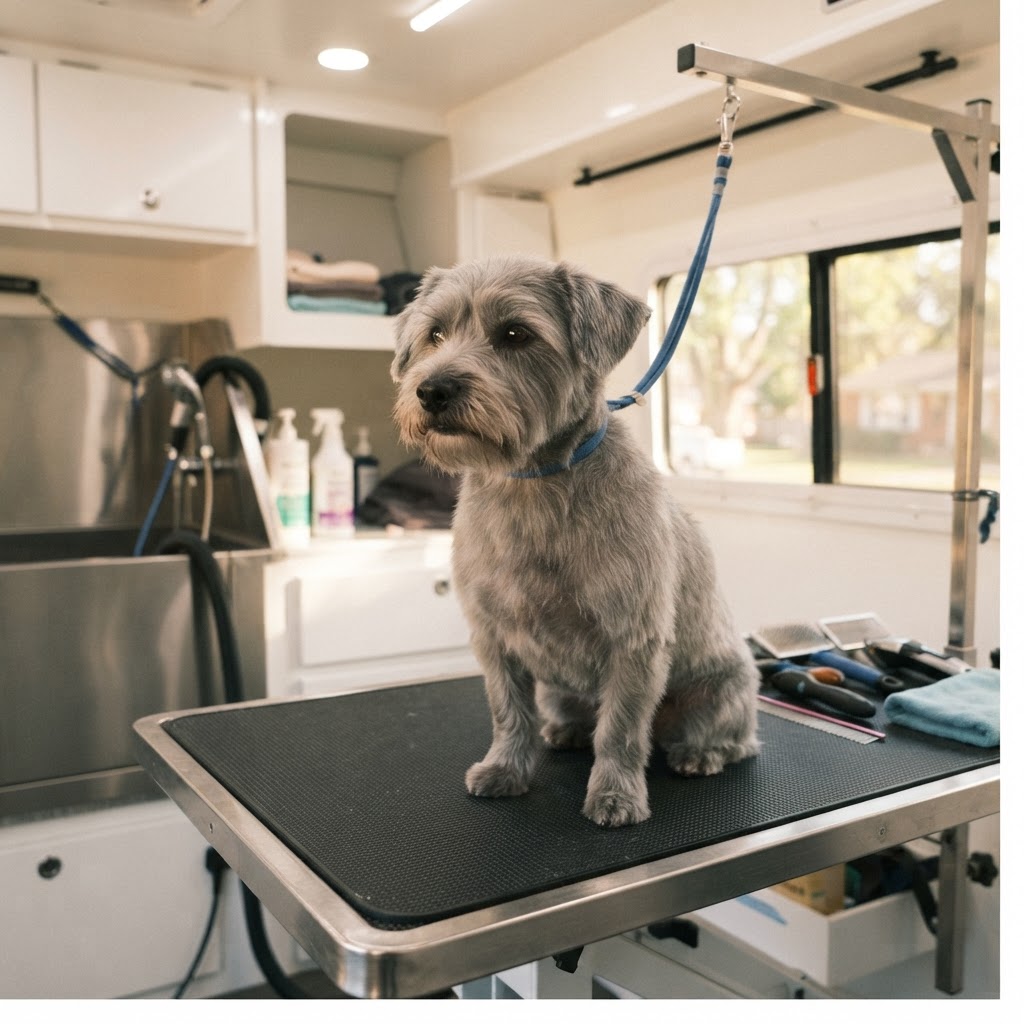
Mobile grooming isn't automatically better for every anxious dog. For some, though, it may help because of:
- Fewer unfamiliar dogs nearby.
- No busy salon waiting area.
- Reduced travel for some dogs.
- Individual attention.
- Familiar home environment nearby.
- A potentially more predictable appointment process.
Every dog is different — think "may", "can" and "for some dogs" rather than assuming.
Rescue and newly adopted dogs
Newly adopted dogs may benefit from time to settle before too many new experiences are introduced.
Tell groomers honestly about:
- Known handling sensitivities.
- Previous grooming experiences.
- Areas the dog dislikes being touched.
- Known bite history.
- Medical issues.
- Mobility concerns.
This is safety information, not judgement. The more a groomer knows, the better they can plan.
Senior dogs
Older dogs may deal with mobility changes, standing fatigue, arthritis or suspected discomfort. Shorter sessions and breaks can help.
Medical concerns should be discussed with your dog's vet.
A dedicated senior dog grooming guide is planned for the future. For now, mention any mobility or comfort concerns when you enquire.
When a groom should stop
Completing every grooming task in one appointment isn't always the priority.
If a dog becomes highly distressed or unsafe to handle, stopping and reassessing may be the responsible option.
Possible next steps:
- Another shorter appointment.
- Additional home preparation.
- Consultation with a vet.
- A qualified trainer or behaviour professional where appropriate.
What to tell your groomer before the appointment
Honest communication helps keep your dog safe and the groom on track.
Share before booking
- Previous grooming history.
- Handling sensitivities.
- Bite or snap history.
- Medical or mobility concerns.
- Areas the dog dislikes being touched.
- Recent surgery or injury.
- Whether grooming has previously been stopped.
- Anything that reliably helps the dog settle.
How Mobile Dog Grooming Bendigo approaches nervous dogs
We work one dog at a time where applicable, communicate with you throughout, and try to understand known sensitivities before we start.
We won't promise an outcome before seeing your dog, and we put safety and welfare ahead of completing every cosmetic task.
See our dog wash and dog clipping services, read our FAQ, or contact us to discuss your dog.
We don't claim veterinary behaviour expertise.
When additional professional help may be needed
Some dogs may need advice from a veterinarian, a qualified trainer, or a veterinary behaviour professional — particularly where there is:
- Severe fear.
- Significant aggression.
- Pain.
- Sudden behavioural change.
- Medical concerns.
A groomer isn't a substitute for that support, and the right professionals can make a meaningful difference.
Low-stress grooming FAQs
Common questions about mobile grooming across Bendigo.
For some dogs, yes — a quieter, one-to-one environment without a busy salon can help. But it's not automatically better for every anxious dog. Some may still need additional preparation or professional behavioural support.
Possibly, but it depends on the dog, the circumstances and how openly the history is shared. Tell us honestly about any bite or snap history before booking so we can consider whether grooming is safe and how to approach it.
Gentle, short handling sessions at home — brief paw touches, light brushing and calm exposure to grooming sounds — help puppies learn grooming is normal. Keep sessions short and positive, and don't force anything.
We may stop the groom. Completing every task in one appointment isn't always the priority — your dog's welfare is. We can then discuss a shorter next appointment, more home preparation, or whether a vet or behaviour professional should be involved.
Yes, always. Handling sensitivities, bite history, areas your dog dislikes being touched and past grooming experiences are safety information. Sharing them helps us plan appropriately — it's not judgement.
Need help with your dog's coat or grooming?
If you're in Bendigo or surrounding areas and would like to discuss mobile grooming, get in touch for a quote.
Free QuoteAbout this guide
This guide was created for dog owners across Bendigo and Central Victoria as general grooming information. It is not veterinary advice. If your dog is injured, unwell, in pain or has an embedded grass seed or other medical concern, contact a veterinarian.